
PACHO
A Curaçao portraitist
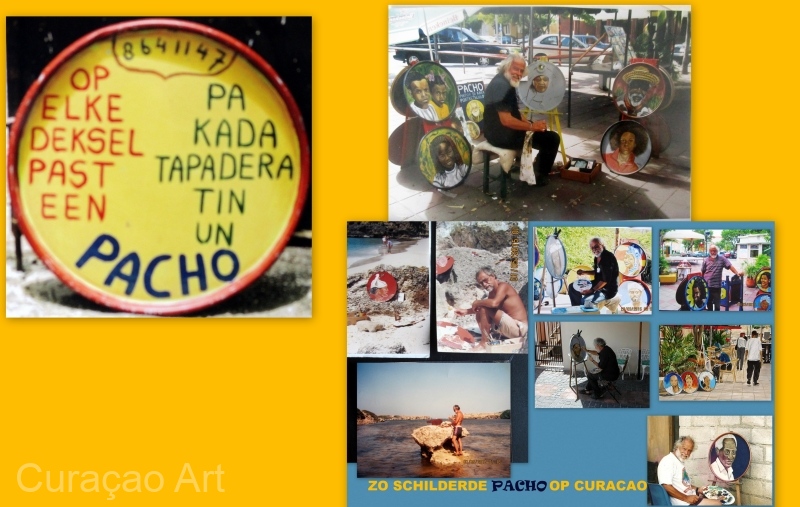
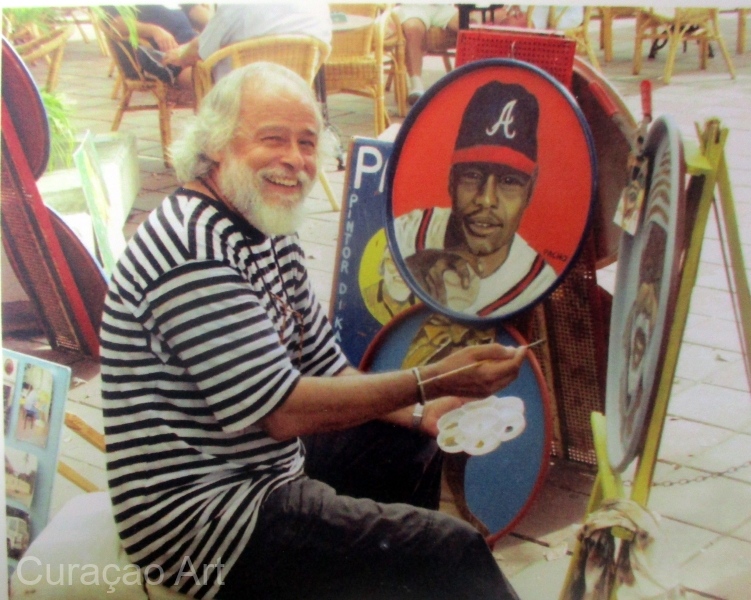
Frans Weeber (Curaçao, 1944) is known in Curaçao as Pacho, the portrait painter. In the late 1990s and still in the early years of the new millennium, Pacho was a familiar face in Punda. Near Wilhelminapark, on the main street sidewalk, he had set up his corner where he could be found daily.
From here, Pacho cheerfully offered his services as a portrait painter. His workspace consisted of an easel, a chair, and a board on which examples of his work were hung. When there were no customers, he was always up for a chat and had a kind word for everyone. Good-humoredly, he would wave worries away with a witticism or a wink. In those years, Pacho was part of the street scene in Punda.
Even though Pacho no longer lives in Curaçao, his work is much loved locally and is present in various private collections, cultural institutions and companies.
Pacho’s childhood in Curaçao
Pacho is the son of Mr. Leon Weeber (1910-1989) and Nora Weeber-Heynen (1910-1994) from Nijmegen, the Netherlands. Pacho’s father was the first Curacaon judge, nominated in 1946. He was appointed president of the Court of Justice of the Dutch Antilles in 1959.
The Weeber family had seven children and lived in a spacious house on the Weg Naar Welgelegen, opposite Plantersrust. Pacho’s father loved sports. He was president of the soccer club Jong Holland and later president of the Curacao Soccer Association.
Fond memories
As a child, Pacho attended St. Willibrord College on Mgr. Nieuwindtstraat in Otrobanda. After that, he attended St. Thomas College on Roodeweg. The Weeber family was Catholic, and Catholic holidays and traditions were always celebrated in full, including birthdays. The family had a yaya (nanny), Shon Bebèl. Pacho cherishes the memory of Shon Bebèl, who assisted his mother in raising and caring for the family.
Other fond memories Pacho has of his childhood are their many pets and the weekly beach visits. Their garden had room for dogs, cats, chickens, ducks, pigeons, turkeys and goats. A regular feature was a visit to the beach on Sunday afternoons. Usually, the family went swimming at Piscadera.
Soccer
As a child, Pacho loved soccer. In the backyard of their house was a large field where he could play soccer with friends from the neighborhood. Because of his father’s presidency at the soccer federation, players from the Curacao team regularly came by. The famous goalkeeper Ergilio Hato (1926-2003), nicknamed “Pantera Negra,” could often be found on the soccer field behind their house. He liked kicking a ball around with the boys whenever he came by. Pacho’s brother, Leon (Jonchi) Weeber, was the most skilled soccer player among the brothers. He made the Curacao youth selection.
There was more than just soccer in the family. Pacho also remembers building huts in the garden with his brothers. With a twinkle in his eye, he recalls that his oldest brother, Carlos (Carel) Weeber, became a famous architect.
Nuns’ prayers
In Catholic families, it was the custom for one of the sons to become a priest. The Catholic nuns were hopeful that Pacho would go to seminary. “Their prayers didn’t help”, Pacho nods. The priesthood did not attract him.
When Pacho was 13, the Weeber family emigrated to the Netherlands. The reason was his mother’s poor health. Moreover, she was homesick for her family.
In the Netherlands
About the forty years he subsequently spent in the Netherlands, Pacho is brief. After high school, he attended the social academy in Holland. Afterward, he started working as a cultural worker.
But his eyes shine when he talks about his love for drawing and painting. Pacho has always loved to paint. During this Dutch period, he would take courses in this field at every opportunity. Painting portraits especially interested him, and he tried to master this in particular.
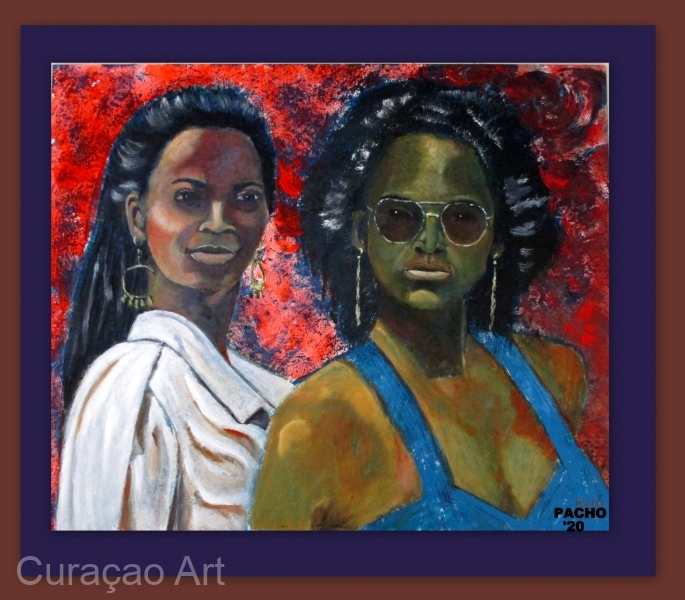
In 1994, Pacho finally returned to Curaçao. He found work at the then-newly constructed Kadushi Cliffs Resort on Westpunt, adjacent to Playa Kalki. In his spare time, he continued to paint. He specialized in portraits, particularly of Afro Curaçaoans.
The ‘lid’ as a trademark
Reusing materials and recycling were things that were on his agenda early on, as was his great appreciation for traditional customs and old utensils. This prompted Pacho to add a unique element to his portraits.
In the 20th century, oil drums from the oil refinery were a common sight on the island. For example, the sturdy iron oil drums were widely reused as musical instruments for steel bands or as garbage containers. In those days, many households had an old oil barrel as a garbage can in the garden.
At one point, Pacho spontaneously tried to see if he could use the lids of these drums to paint on. This actually worked out very well. From then on, he used these lids as the ‘canvas’ for his paintings. The round screw hole in the lids did not bother him. He creatively incorporated them into his portraits. The lids became his trademark.
Success as a portraitist
With this original find—portraits on the lids of oil drums—Pacho then promoted himself as a portraitist. Pacho drove a vintage automobile, a classic wooden truck, which he used for touring guests of Kadushi Cliffs. He decorated the car with these portraits. It was original, and everyone loved it. Pacho enjoyed the many positive comments he received.
Solo exhibition ‘Yu di Kòrsou’
At the opening of Lusette and Herman Verboom’s art gallery ‘Gallery Alma Blou’ in 1996, Pacho was the first painter to exhibit there. The opening speech for ‘Yu di Kòrsou’ was delivered by none other than the author Frank Martinus Arion (1936-2015). On this occasion, Pacho recalls, Frank pointed out that he was pleasantly surprised to meet someone who gave the Curaçao people a dignified place in international art history. For Pacho, the author’s statement was a sign that he was on the right track. From then on, he continued to portray the people of Curaçao.
As Pacho preferred the outdoors, he chose not to have a studio. Instead, he planted himself on the sidewalk of the Breedestraat in Punda to offer his services as a portraitist.
The solo exhibition ‘Yu di Kòrsou’ had been a great success and contributed to his recognition. As a result, he received more commissions and invitations for other exhibitions. He was interviewed for Ashley Mauricia’s “Arte pa Tur” art program. In 2002, he was part of the delegation of Curacao artists who participated in the ‘Festival del Fuego’ in Cuba.
Since then, Pacho has created over 600 portraits on the iron lids. He even made a double portrait of King Willem Alexander and Queen Máxima, and had the opportunity to present it to the royal couple.
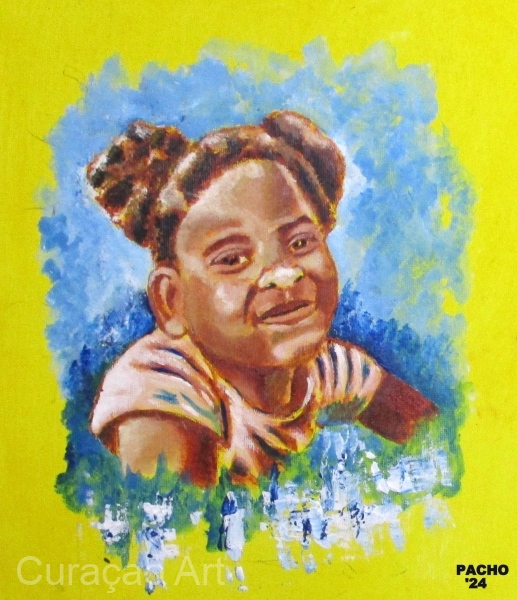
Pacho is now eighty years old, and he still mainly paints portraits of the Yu di Kòrsou.
Emigration
In 2007, Pacho left for the Netherlands for the second time. Although he no longer lives in Curaçao, he cherishes the connection with his native island. He continues to paint portraits of Curaçaoans and maintains contact with his overseas audience through Facebook.
In the Netherlands, he joined the artist association Het Goudse Palet. Here, he has a studio and participates annually in the Association’s exhibitions. He still paints portraits of the Afro Curaçaoan, but they are not always on lids anymore.
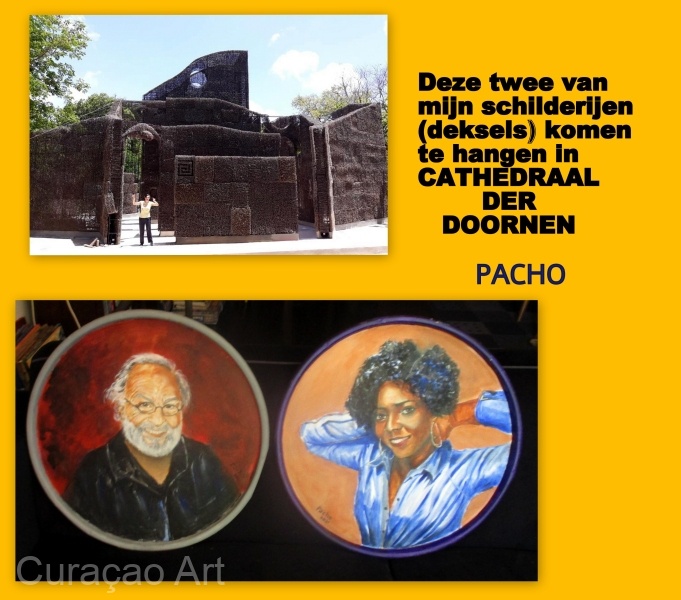
In 2021, Pacho donated two portraits on lids to Herman van Bergen‘s Cathedral of Thorns, one of which is a self-portrait.
In 2022, on his 78th birthday, he made a digital compilation of all the portraits he painted and sent it to the Antilliaans Dagblad as a gift for Curaçao. “I will continue to paint the Dushi Yu di Kòrsou,” he wrote along with it. The newspaper printed it prominently on the front page with the headline “Gift from Pacho”.
Art is communication
For Pacho, art is communication, beginning with the collaboration between artist and client. Pacho believes art should reflect local culture and highlight it in a recognizable, profound, or even critical manner. In this way, art can contribute to a community’s growth and awareness.
©Written by Josée Thissen-Rojer (2024). When reproducing the text above, please credit the source: Curaçao Art®️ www.curacao-art.com. The artist retains all image rights of their artworks.