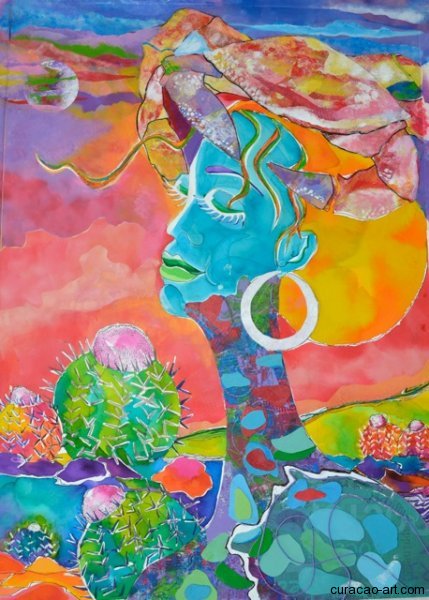

Her paintings are colorful and imaginative. She depicts mostly women surrounded by a variety of symbols, such as the sun, cactuses, and all kinds of small animals. The public appreciates her work for its bright, joyful colors and apparent lightheartedness.
Suzet Rosaria (1965) was born and raised in Curaçao, a place that profoundly influenced her artistic journey. In the course of her high school years, one of her teachers recognized her talent and encouraged her to apply to the fine arts academy in the Netherlands. During the seventeen years that she stayed abroad, she maintained a strong bond with her native island. Her roots are so firmly planted in Curacao that she would never paint the picturesque Dutch mills, farmhouses, or canals during her training at the art academy. Instead, she chose to paint Caribbean scenes related to her youth in the tropics. She finally returned to Curaçao in 2001 and has since been exhibiting and participating in events with regularity.
Suzette developed her colorful style in her last year at the art academy. Her paintings are filled with people, primarily women. The figures are often accompanied by an array of plants and small animals originating from a childhood spent in her grandmother’s garden. Suzet applies them as symbols to emphasize the role of women in the community. She grew up observing women’s strength and ability to endure hardships while maintaining their positivity.
As an artist, she transfers these experiences to the canvas. Suzet uses cactuses as a symbol of the hardships of life. A lobster refers to the many tasks women carry out. The bright sun denotes a woman’s positive attitude because, after rain or storm, the sun will always shine again. Ultimately, this is the message she wants to disclose through her work: the unfailing ability of women to endure, care for, and overcome.
An intriguing part of Suzet Rosaria’s work is her series of objects titled Korona di Kabes (Crowns for the Head). These pieces were exhibited in the Curaçao Museum during the exhibition Antepasado di Futuro (Forefathers of the Future) in 2010. By creating the Crown series, inspired by the intricate Afro-Caribbean hairstyles, she offered recognition to the Afro-Caribbean female. It was a tribute to strong Caribbean women like her mother and grandmother and to womanhood.
2013: Text by Josée Thissen-Rojer.
© Copyright.
When reproducing our texts, acknowledgment of the source, Curaçao Art® www.curacao-art.com, is required. All photographs and images of artworks are protected by copyright laws.
See our blog on her solo exhibition in 2021: E Wega di Bida (The Game of Life).
Training
1994 – 1997 Ichtus Academy, Rotterdam, the Netherlands.
1989 – 1993 Fine Arts Academy, Amsterdam, the Netherlands.
1986 – 1989 Amsterdam Academy, the Netherlands.